
SMET Waste Stream Report 2025-2026
Waste Stream Report – Reporting Period: April 2025 – April 2026
Executive Summary
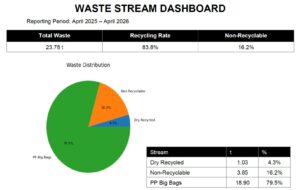
Total waste generated during the reporting period was 23.78 tonnes. The recycling and recovery rate, including polypropylene (PP) Big Bags, was 83.8%, with non-recyclable waste accounting for 16.2%. Performance is driven by strong packaging recovery systems.
SMET Waste Stream April 2025 -2026 – Click to open report
Key Insights
• Strong circularity driven by PP bag recovery
• Dry recycling underutilised – an improvement opportunity
• Residual waste remains key reduction focus
Action Targets (2026–2027)
• Increase recycling >90% diversion
• Reduce non-recyclable waste <10%
• Expand closed-loop Big Bag system
Aligned with ESG and Circular Economy principles | Focus on material recovery and landfill reduction
Waste Stream Analysis
Dry Recycled Materials (1.03 tonnes | 4.3%): Includes cardboard, plastics, timber, and metals. Fully segregated and recycled.
Non-Recyclable Waste (3.85 tonnes | 16.2%): Includes contaminated packaging and mixed waste. Key area for reduction.
PP Big Bag Recycling (18.9 tonnes | 79.5%): Dominant stream. Bags are reused or recycled, supporting circular economy objectives.
ESG & Circular Economy Alignment
The waste management approach supports reduced environmental impact, lower Scope 3 emissions, and improved material efficiency through closed-loop systems.